This group covers the basic passive building blocks of every radio circuit: resistors, capacitors and inductors, along with switches and batteries. Knowing what each part does, and what it stores or opposes, answers most of the questions here.
Resistors and potentiometers
A resistor opposes the flow of current in a DC circuit, turning some electrical energy into heat. Resistance is measured in ohms. A fixed resistor has one set value, and a power resistor is a fixed resistor built to dissipate more heat.
A potentiometer is a resistor whose value you can change by turning a shaft or moving a slider. The electrical parameter it controls is resistance. Because it lets you adjust a signal level smoothly, it is the part often used as an adjustable volume control. Do not confuse it with the variable capacitor (adjusts capacitance) or the variable inductor (adjusts inductance).
Capacitors
A capacitor consists of two conductive surfaces, called plates, separated by an insulator called the dielectric. It stores energy in an electric field. Capacitance is measured in farads, although practical parts are microfarads, nanofarads or picofarads.
Inductors
An inductor is typically a coil of wire, often wound on a core. Current through it creates a magnetic field, and the inductor stores energy in that magnetic field. Inductance is measured in henries.
A handy way to keep these straight: capacitor equals electric field, inductor equals magnetic field. Resistors do not store energy; they dissipate it.
Switches
Switches are described by poles and throws. A pole is a common circuit path, and a throw is a position the switch can connect to.
- SPST (single-pole, single-throw): one circuit is opened or closed. This is a simple on/off switch.
- SPDT (single-pole, double-throw): one circuit is switched between one of two other circuits.
- DPST (double-pole, single-throw): two circuits are opened or closed together.
- DPDT (double-pole, double-throw): two circuits are each switched between one of two other circuits.
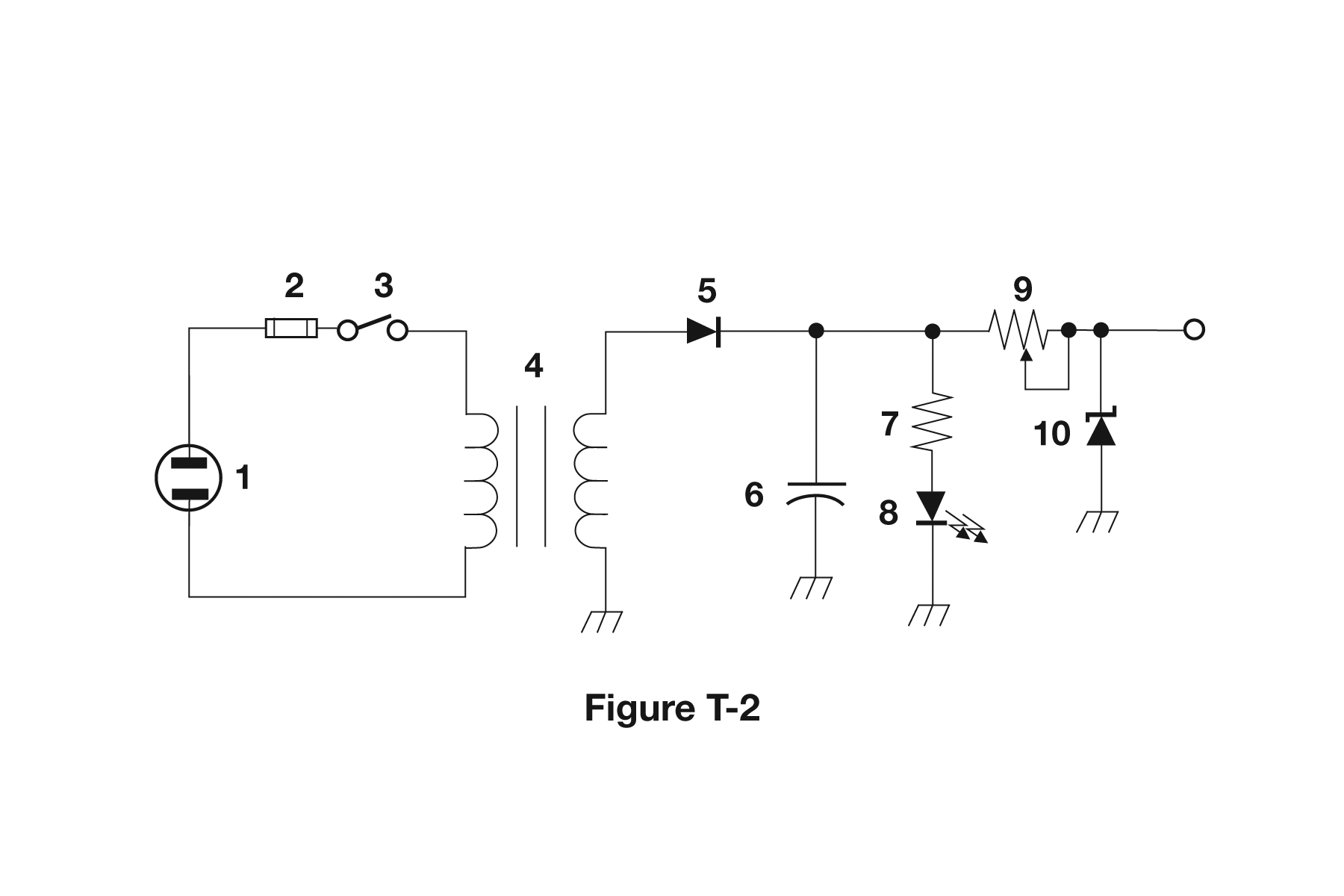
In schematics, a simple switch drawn as one blade with two terminals is SPST. In Figure T-2, component 3 is such a switch, placed in series with the fuse at the AC input. It turns the whole supply on or off, so it only needs to open or close a single circuit.
Fuses
A fuse is a protective device with a thin link that melts when current exceeds its rating, opening the circuit. It is shown in Figure T-2 as component 2, just ahead of the switch. Always replace a fuse with the same current rating.
Batteries
Batteries come in two broad kinds. Rechargeable (secondary) chemistries can be restored by pushing current back through them. Non-rechargeable (primary) cells cannot.
| Chemistry | Rechargeable? |
|---|---|
| Nickel-cadmium (NiCd) | Yes |
| Nickel-metal hydride (NiMH) | Yes |
| Lead-acid | Yes |
| Lithium-ion | Yes |
| Carbon-zinc | No |
Trying to recharge a primary cell such as carbon-zinc can cause leaking or rupture.
Key facts to memorize
- Resistor: opposes current flow in a DC circuit (unit: ohm).
- Potentiometer: variable resistor; controls resistance; used as an adjustable volume control.
- Capacitor: two plates separated by an insulator; stores energy in an electric field (unit: farad).
- Inductor: coil of wire; stores energy in a magnetic field (unit: henry).
- SPDT: one circuit switched between one of two other circuits.
- SPST: one circuit opened or closed (Figure T-2 component 3).
- Rechargeable: NiCd, NiMH, lead-acid, lithium-ion. Not rechargeable: carbon-zinc.
Memory hooks
- Capacitor: “C” for charge in an electric field. Inductor: “coil” and magnetic field.
- Count the poles (circuits controlled) first, then the throws (positions per pole).